Brazilian Artist Lucas Lopes: ‘Handmade Art in the Age of AI is an Act of Rebellion'
In this interview, Lucas shares how Sufi mysticism inspired him, why he creates handmade art despite AI, and why he's opening an atelier in Barcelona
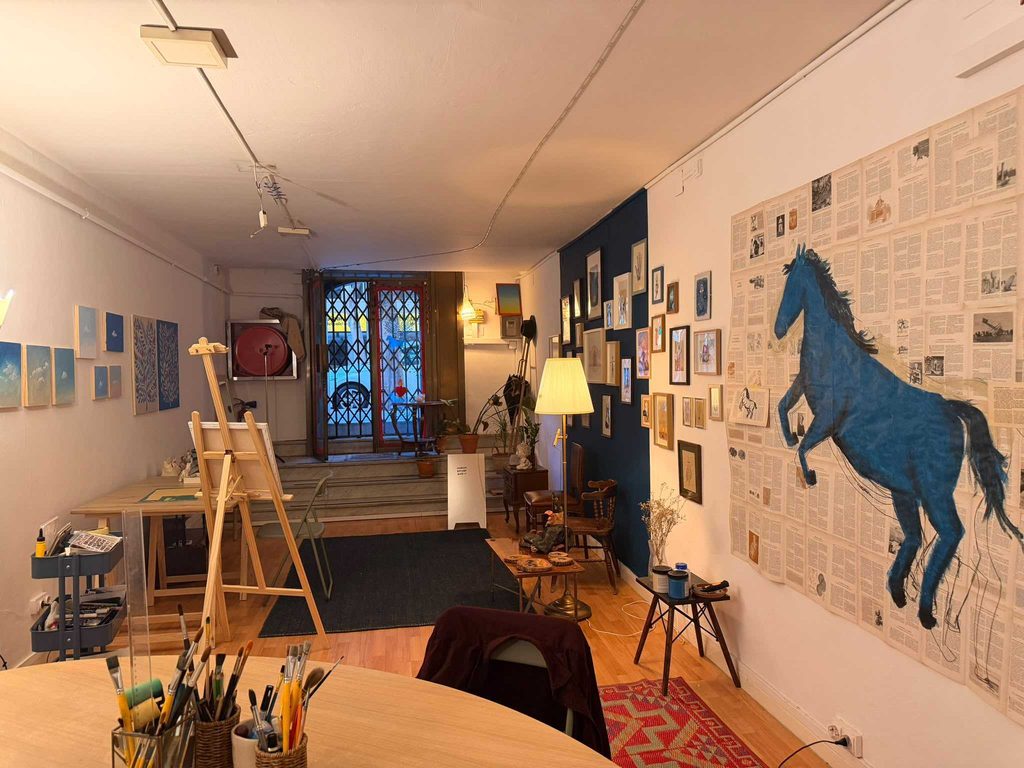
When I arrive at Lucas's soon-to-open atelier on a sweltering September evening in Barcelona, I find him sitting at a large wooden table in the centre of the room. Images of horses sketched on sheets of brown paper are scattered across it. Clad in khaki trousers, a black and white striped tee, and a red shirt, Lucas greets me and points at a sketch in progress, “I’m working on a mural for the left wall.”
The atelier seems even more welcoming since my first visit in July. Part of the blue and white left wall has frames of Lucas’s illustrations, while the right wall showcases poetry and other art by local artists. The space has been furnished with an easel, two desks, and shelves with books on illustration and storytelling in Portuguese, Spanish, and English. There are lamps that give a cozy yellow glow, and little puppets with funny faces in nooks and crannies.
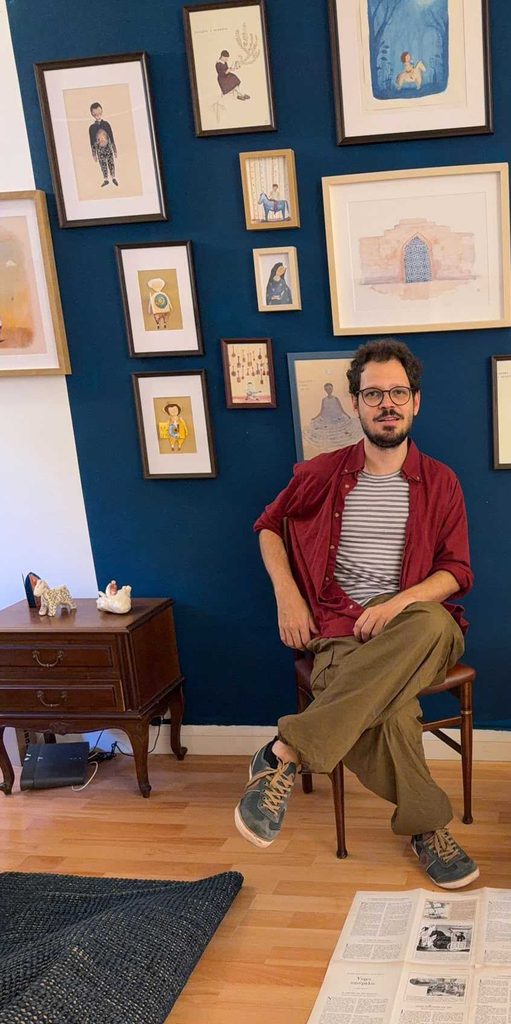
Lucas was born in Uberlândia, and has lived in different cities in Brazil. He beams when sharing what attracted him to visual art.
“My mom says I started drawing before I could speak. Working with chalk and colour pencils was my first form of expression. My mom worked at a school when I was little, so she left me in the library until she finished. It’s where I became fascinated by children’s books and illustration, more importantly. I discovered the book The Little Prince in adolescence, which is impossible not to mention when considering my art. Aside from the watercolour aspect, [which I adore] the book’s metaphors made a large impact on my life—teaching me how adulthood and childhood can meet on the page,” he says.
How Lucas Experimented with Watercolours and Became a Visual Artist in Brazil
With no watercolour courses or teachers in his town, Lucas reached for watercolour pencils. Their magical quality urged him to take a course in art and drawing at the music conservatory. His teacher gifted him a basic set of watercolours, which made Lucas fall in love with the material. He began exploring how to use them for illustration from then onwards.
Lucas points at the frames of illustrations on the wall.
“When I teach art, I always tell people to play while they are creating. I believe it's one of the ways to explore, discover, and also be open to what can happen with the materials.”
The combination of watercolours with motifs such as the sun, moon, and stars, are ever-present in his works. They come alive through tactile, moving parts such as hearts that open to show inner worlds, hands that hold objects, and hats, shoes, and wands that can be removed and played with.
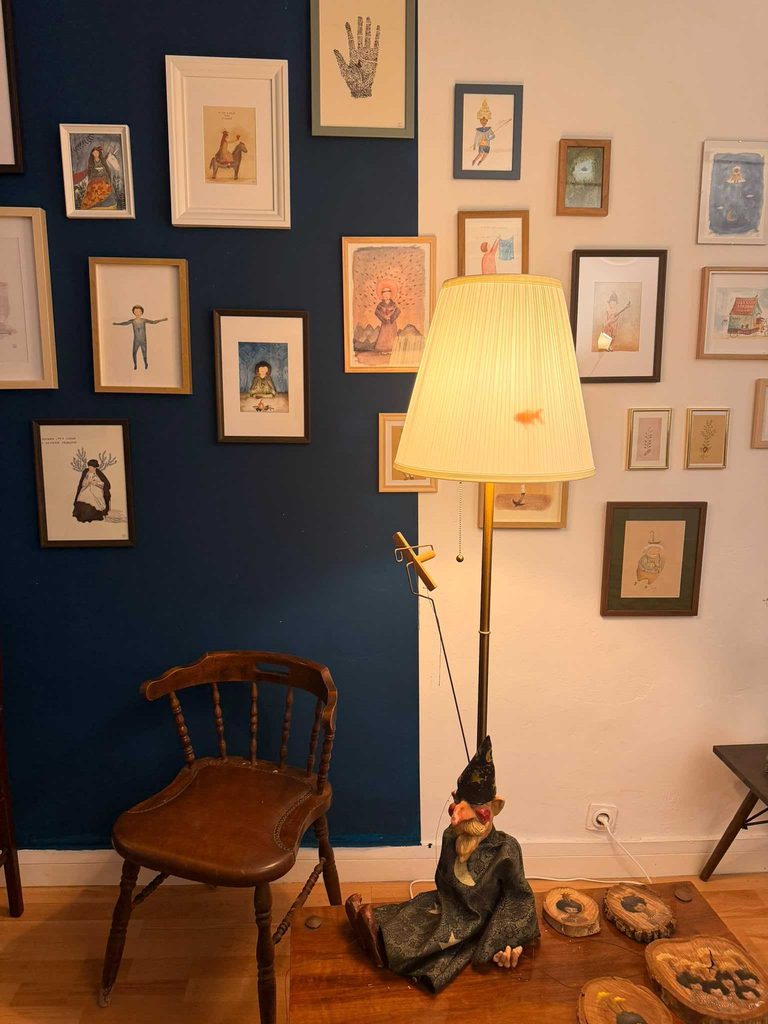
“For example, clouds symbolise impermanence and change—they exist, but you cannot touch them. Ladders, on the other hand, lead you to other spaces and places. I remember these images from my childhood, and now I incorporate them to convey ideas beyond words.”
Lucas opens a box of pumpkin seeds to share. I take a sip of water before we move on to discuss how Sufi poetry, concepts, and stories became part of his art.
“First, I believe Eastern languages possess something that Western languages tend to lose in poetry. I was recently researching the Portuguese language: one of its first major milestones was Troubadour poetry: a 12th–13th century literary movement influenced by the Hispano-Arabic world. It influenced the first great literary movement of the Portuguese language, which made speaking about life common through poetry. All the motifs in my art are linked to it.”
How Sufi Poetry and Tales Helped Lucas Grasp the Concept of Oneness and Inspired his Works
He continues where he left off. "There’s a saying by Rumi I cherish: Man is a miniature universe. It’s the idea that everything outside us is a reflection of what is within us, and vice versa. The figures I draw—which contain symbols and elements—remind me that our inner world is just as grand and impressive as what is visible outside. Human beings have the capacity to hold moons, mountains, and the sun within, taking our imagination to a level of knowledge that the west lost or never managed to hold. The entire east has this, not only in its traditions, but in daily life.”
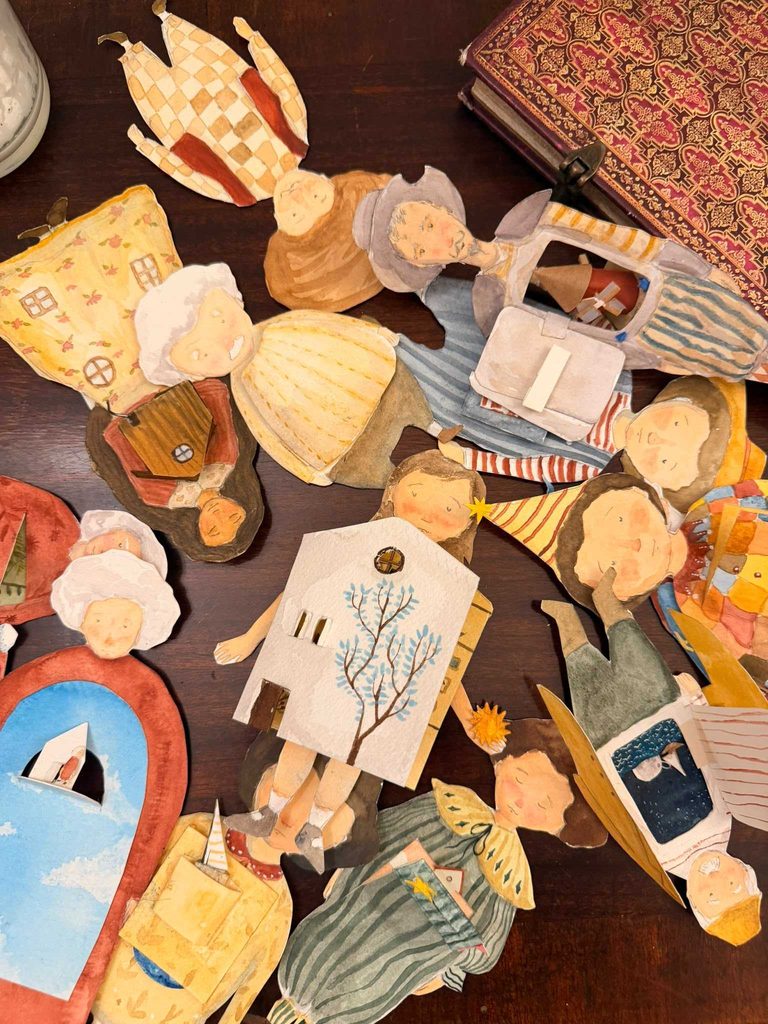
The commercialised side of Sufism—whirling dervishes and eight-pointed stars—is not Lucas’s focus, nor are the religious aspects. He prefers to subtly incorporate the search for beauty from Sufi poetry into his works. Someone who knows his visual art would hardly be able to say, "Ah, this is directly inspired by Sufism." The connection is implicit.
We stop chatting and turn around to look at the atelier’s glass doors, where a little boy is squealing with joy while pointing at the images Lucas has painted on them. His parents are equally fascinated, peeking in to see what is beyond the gorgeous entrance. A few minutes later, they walk away.
Lucas, now with a twinkle in his eye, peels a pumpkin seed before continuing. “I have no problem talking about it even though there can be prejudices nowadays, since Sufism comes from Islam [which faces stereotypes]. I find it limiting if we don't open ourselves to learning from everything around us. Rumi is very popular eg, and people have an interest in what feels exotic, which is fine as a first impression. However, my work isn't geared at making people join any spiritual or religious group. I prefer helping them with self-knowledge through art; to realise that gentleness, dreams, and the inner life carry deep meaning and importance.
In my own art, I try not to take that obvious, commercial path either. In fact, my atelier is named Cavall Mágic (Magical Horse) after a Sufi story—the tale of the magical horse—which was the first one I heard at a storytelling festival while working in São Paulo. I felt there was a deeper meaning to what was being narrated. It’s a long story, but in a few words, the mechanical fish in the story could go forward, backwards, upwards, and sideways but the wooden horse could go within. It could take the direction of the heart, which is one of the key symbols in my work. Similarly, my atelier carries this essence of researching what happens within our internal landscapes. There are many such stories embedded in our daily lives without us realising their Sufi origins.”
Hearing that first story inspired Lucas to research Sufi poets and teachers: Rumi, Hafiz, Omar Khayyam, and Ibn Arabi. He now has a group of friends with whom he shares these stories, poems, and teachings. He also takes great inspiration from the books of Idries Shah, a contemporary Sufi who brought Sufism and its teachings to the Western world while living in England.
But Lucas is one of the artists who has returned to analogue art after jumping on the bandwagon of digital drawing. When the technology was novel, he created characters with a starry sky behind them on a tablet. A major effort that took over two days was animating one character's body so it would disappear and leave only the stars behind. The body would reappear to illustrate a poetic idea about breathing and dissolving into the universe.
The Effect of AI on Visual Art and why Lucas Believes Handmade Art is an Act of Rebellion
“Suddenly, AI arrived, and people could animate a work like mine in 30 seconds. I felt the rules of that digital game no longer suited me when I witnessed that, so I looked for another way to play. I returned entirely to drawing, cutting, and pasting things by hand on paper. It was an act of rebellion. And we see it all around us too: people are tired of AI slop. They want to disconnect and go back to the little joys of creating with their hands and without a screen,” he says.
He doesn’t dismiss that AI is affecting artists, however. He shares a story about a man who lived in a village with his wife and children.
“It was a very isolated place and the man had to work hard just to access water. He woke up each day to fetch it from a well that was miles away. One day, he left his village to visit an old friend in the city. When he arrived, he entered his friend's house. The friend offered him some water, and walked to a wall where there was a tap. He opened the tap and water came out. The man from the village was surprised. It was something magical and he wanted to replicate it so he wouldn't have to work hard to fetch water. He returned to his village and put a tap in the wall of his home, not realising how important plumbing was.
This story was told at an event by my friend Bia Machado, who used it as a metaphor for knowledge when speaking about Sufism and Ibn Arabi. Just as learning requires a process—an invisible system of pipes, so to speak—we are now using and receiving information from AI. But it isn’t necessarily learning because the process itself is missing. There is no “plumbing”. Knowledge doesn’t reach us because we haven’t built that invisible structure of learning for it to flow.
I take security in knowing that, whether AI exists or not, manual work will continue because it is intrinsic to our lives. AI cannot learn what people do because we don’t just learn from what we are seeing, but also through our hands, bodies, and mistakes. All of this creates a language, which enables us to create unique pieces. No one can take that away,” he says.
What He Hopes to Achieve with and the Reason for Opening Atelier Cavall Magic in Barcelona
Lucas’s motivations for opening the atelier are geared at fostering a connection with the self and the community. He thinks of it as an internal tourism agency: a place for people to take journeys within rather than outward to distant places.
“The workshops I want to teach, my drawings, and my overall works are an invitation to explore what is inside us."
"I want to create keys for people to open up, explore, and play. It will be the first time I will have my own atelier; I always drew and painted on my kitchen table at home. Having a dedicated space where I can arrive, have my materials ready, and not have to clear them away for dinner allows me to look at my work process with more time. It's also a way to connect with people beyond social media—allowing locals, neighbours, and fellow artists in the city to immerse themselves in this universe through shared workshops and exchanges.”
It turns out not only writers need a room of their own, and we exchange nods and anecdotes when discussing Virginia Woolf’s famous book which spread this idea of having a sacred space to oneself. Speaking of books, Lucas has been commissioned to illustrate children’s literature several times, for which he won prizes such as the PNLD in Brazil. Even so, he remains humble about winning awards and what they mean for him as an artist.
“Artists are often placed on a high pedestal in society, which makes it harder for people to claim that title for themselves. If you go to a classroom of five-year-olds to ask who is an artist eg, everyone raises their hand. In a lecture hall of law or business students at university, maybe one or two will raise a hand, because along the way, we are taught that art isn't for everyone.
I remember one of the first times I was invited to paint a large 20-metre mural at a cultural centre. It was closed that day, but a child walked past it with his mother and said, "Look mom, an artist is painting!"
I looked around and realised he was talking about me. Receiving that title from a little child—rather than the formal art gallery world—was deeply rewarding and humbling. I am grateful for winning the PNLD in Brazil (where select children's books are acquired for public schools across the country or festival curations). I view them as part of the process—like planting corn and harvesting it later. But I feel awards don't define whether you are an artist or not.
Moreover, with a background in community pedagogy, I’ve always worked as an educator. I'm more interested in group work than simply showcasing a grand work of my own. I’ve taught art in the outskirts of São Paulo, at juvenile detention centres, and to elderly people at care homes. These experiences taught me that learning isn’t as obvious as it seems. Education must be built in community and adapted to context. In this, I am influenced by educators such as Paulo Freire,” he says.
This interest to educate aligns with Lucas’s intention to nourish the world as an artist. He wants to create images that empower, comfort, and inspire people. He endeavours to bring light and attention to small, fragile, or forgotten things that often go unnoticed, especially since we are dominated by urgency and digital distraction. And the latter, as we know, isn’t easy.
He agrees and elaborates. “Whenever I share lists of required materials for my classes, I tell attendees that alongside paper, paint, and scissors, they need two invisible yet essential tools: patience and gentleness (kindness).”
Lucas believes that artists who want to work with deeper themes—like dreams, the heart, or the inner world—should treat them as tools rather than creating art based on fixed recipes or moral rules.
“Use patience and gentleness with yourself throughout the process. The work of an artist is to shine light on what goes unnoticed, bringing care and attention to the small things to nourish others.”
For those who dream of creating art but feel they aren't capable or don't have the talent, he has another message.
“Focus your attention on the dream rather than on the feeling of not being capable, because self-doubt will always be present. Even in my own work, there are days I look at what I'm making and think: what am I doing? I don't like this at all. But the next morning, I remake it and keep going. Being patient and gentle with yourself allows you to keep experimenting and learning through your hands, eyes, and mistakes.”
Atelier Cavall Mágic's inauguration will feature a joint exhibition of art and poetic works from artists Ailin Casas, Longchemin, Francisco Díaz, and Lucas Lopes on September 26, 2026 at 19.00hrs. Come along if you’re in Barcelona. In the meantime, feel free to follow Lucas’s creations on Instagram.
Raksha Daryanani Thani is a freelance writer, editor, and presenter in Barcelona. She enjoys writing about ordinary people doing extraordinary things all over the world. This article is not a paid promotion.